
Barry Hudson
LinkedIn →
30+ years in sales, marketing, and business development across technology, construction materials, and logistics sectors.
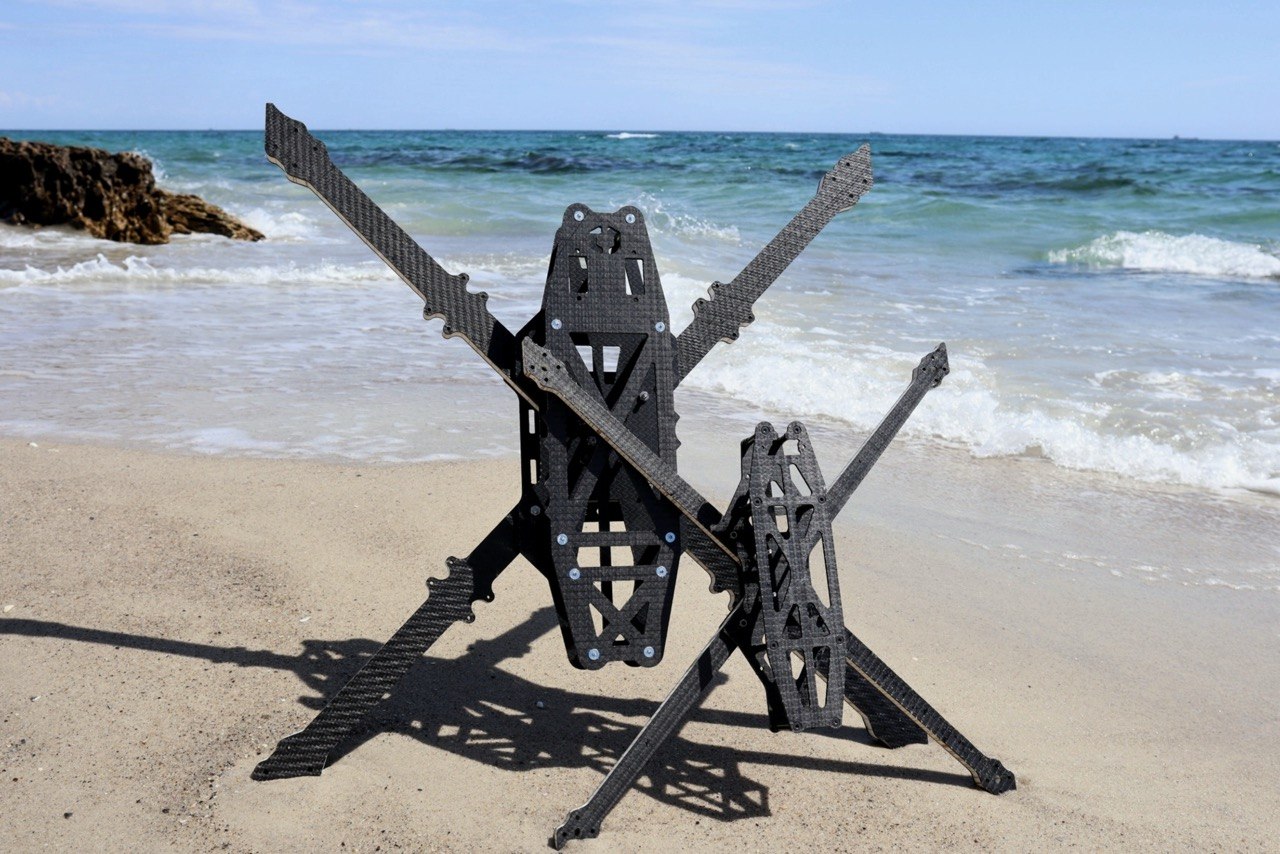
Ultra-lightweight composite airframes that increase range, payload capacity, and loiter time for heavy-lift quadcopters — without requiring changes to batteries or motors.
Every extra kilogram of structure reduces available energy for distance, payload, and flight time, forcing operators to trade range for payload or vice versa.
Stock heavy-lift airframe. Range and payload are fixed by structural mass. Operators are forced to give up one to get the other.
Lower structural mass releases battery energy back to the mission. Same battery, same motors, more range, more payload, more loiter — verified end-to-end.
Frontline NextGen designs and supplies lightweight composite airframes and powered airframes for high-performance drones.
The reduced structural mass lowers the total weight that must be lifted throughout the mission, increasing available battery energy for range, loiter time, and payload.
Programmes today are running on Baba Yaga / Vampire-class platforms, validated against real round-trip mission profiles — not bench numbers.
Tested with a 2×6S battery configuration, 5.0 kg total battery mass. Solid lines are measured; dashed lines are conservative worst-case (wind, temperature, safety margins) that remain operationally usable.
Total battery mass tested.
At target with payload, both configurations.
Verified safe return after payload drop.
Technical credibility, operator credibility, and bilateral defence-policy reach in one team.
30+ years in sales, marketing, and business development across technology, construction materials, and logistics sectors.
1,400+ hours of combat UAV flight time and 100+ executed missions. Custom quadcopter and fixed-wing UAV design, ArduPilot / Pixhawk / MAVlink, ISR and ordnance delivery. Former USMC Infantry Marine.
Business Development Manager, DLF attorneys-at-law Ukraine. Extensive miltech and defence stakeholder networks.
Executive, Main Directorate of Defence Intelligence Ukraine. Defence Ukraine Specialist and MilTech Consultant.
Composite layup, geometry, and process IP secured before disclosure.
UK engineering support paired with a Ukrainian production workshop close to the operator.
Iteration loops driven by the units actually flying these airframes.
Ukrainian manufacturers of high-performance quadcopters, multirotors, and heavy bomber drones — looking for component-level airframe gains without re-engineering propulsion.
Ukrainian military units seeking component-level performance upgrades to fielded heavy-lift platforms.
For technical specifications, prototype evaluation, or joint development.